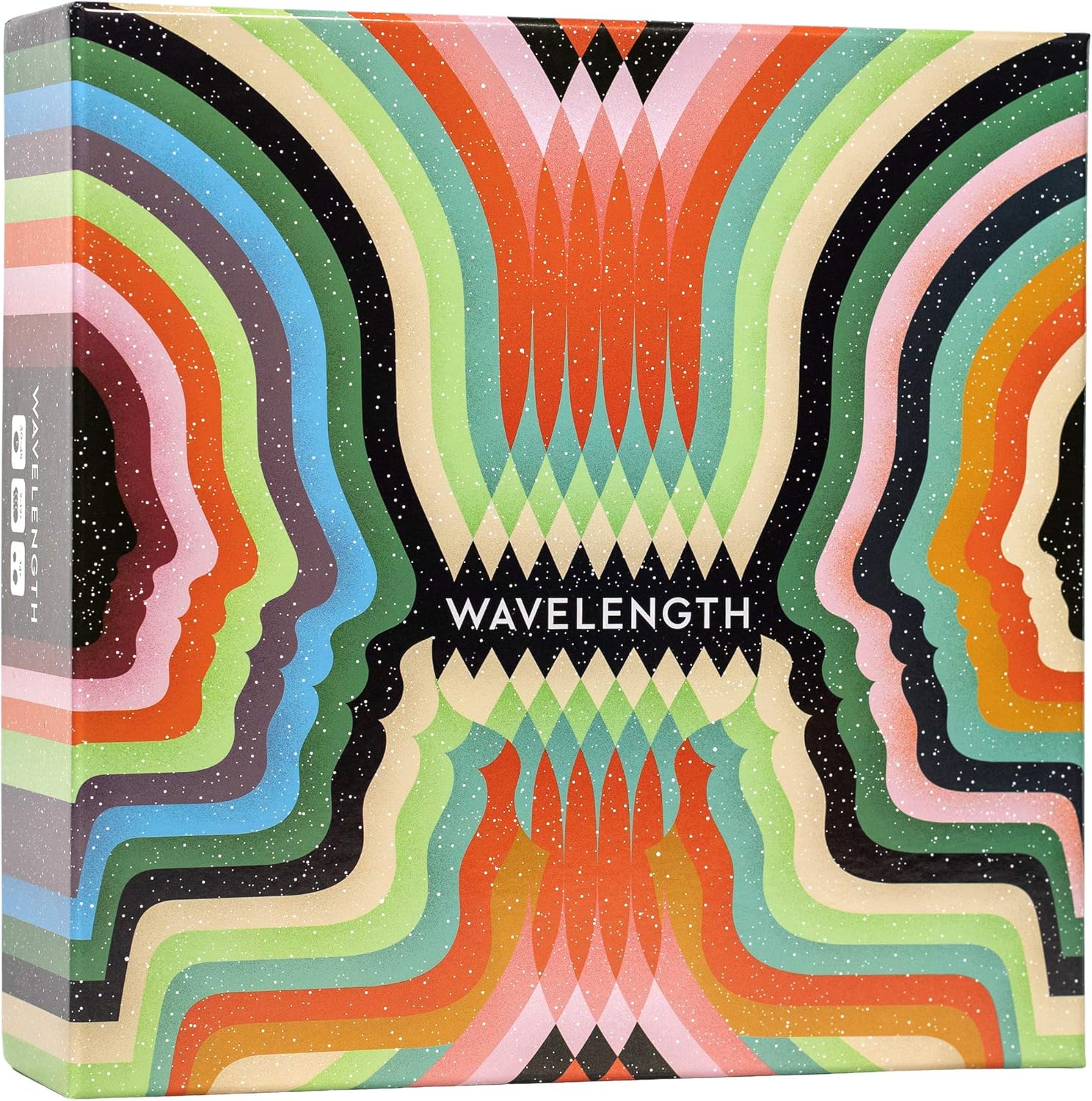
 Product image from current catalog data
Product overview
CMYK Wavelength: What to Know
The mechanic is the cleverest in this guide. A dial hides a target somewhere on a spectrum running between two opposites, hot or cold, soft or hard, wizard or not a wizard, and one player gives a clue they think sits at that exact point. The team then argues about where on the spectrum the clue falls and turns the dial to their answer. The comedy is entirely emergent, produced by the arguments rather than by the cards, which is why it works in rooms where a deliberately offensive game would not.
The practical specifications are the reason to own it. CMYK states five seconds to set up, one minute to learn and thirty minutes to play, and all three are unusually honest for a party game: there is no scoring to explain, no hidden roles and nothing to deal out. Player count runs from 2 to 12 or more, which covers a couple, a dinner party and an office offsite with the same box.
It is also cooperative in structure, with teams working together to read each other, which changes the social dynamic: nobody is being judged on their taste, and a quiet person is not exposed. The publisher cites Polygon calling it one of the best party games they have played and a listing in the New York Times Wirecutter's best board games, which are the publisher's citations rather than ones we have verified.
The stated age is 14 and up, with an age field of adult and young people. That is driven by the abstraction rather than content: placing a clue on a spectrum requires holding two opposites in mind and judging a gradient between them, which younger children find genuinely difficult. There is nothing in the box unsuitable for a child; they will simply struggle to play it well.
Key Listed Features
Cooperative spectrum-guessing: one player clues a hidden point between two opposites and the team dials in an answer
Stated five seconds to set up, one minute to learn and thirty minutes to play
Two to twelve or more players, the widest practical range in this guide
Manufacturer recommended age of 14 and up, driven by abstract reasoning rather than content


