TopFiveFind may earn from qualifying purchases. Rankings are editorial starting points, not hands-on test claims.
Home/Vacuum Sealers/SONY E 55-210mm F4.5-6.3 Lens for SONY E-Mount Cameras (Black) (Renewed)
SONY E 55-210mm F4.5-6.3 Lens for SONY E-Mount Cameras (Black) (Renewed)Product image from current catalog data
Best Budget Reach

SONY E 55-210mm F4.5-6.3 Lens for SONY E-Mount Cameras (Black) (Renewed)

By Sony

8.9Excellent matchFeature and use-case score

An 82 to 315mm equivalent reach with OSS, internal focusing, and a focus ring that does not rotate during autofocus, which matters more than it sounds.

  • APS-C E-mount 55 to 210mm, framing like 82 to 315mm, with a seven-blade aperture
  • Optical SteadyShot stabilisation, which is what makes a 315mm equivalent handholdable at f/6.3
  • Internal focusing with direct manual focus and a non-rotating focus ring during autofocus
See Price at the store →Price, delivery, and configuration can change at the retailer.
ByTopFiveFind Research Desk

How this was made: AI-assisted research and drafting organize the evidence. Exact product identity, source claims, owner-feedback patterns, conflicts, and publication checks are documented before indexing. No hands-on or human-expert testing is claimed unless a page explicitly shows that evidence. Read the full methodology.

Best fitBest Budget Reach
CategoryVacuum Sealers
BrandSony
Catalog score8.9 / 10

Product overview

Sony E 55-210mm F4.5-6.3 OSS: What to Know

This is the cheap reach option for an APS-C Sony body and three of its specifications are better than the price suggests. Internal focusing means nothing extends or rotates as the lens focuses, so the overall length stays constant and, critically, the focus ring does not rotate during autofocus. Sony calls that direct manual focus with a non-rotating focus ring, and the practical consequence is that you can rest a hand on the ring, tweak focus mid-sequence, and use a polarising filter without it being spun out of alignment every time autofocus moves. The Canon EF 75-300 in our DSLR guide fails on exactly this point.

Optical SteadyShot stabilisation is the second, and it is what makes a 315mm equivalent handholdable at f/6.3 at all. The third is a seven-blade aperture, which keeps out-of-focus highlights reasonably round.

The range is the attraction. Fifty-five to 210mm on APS-C frames like 82 to 315mm, which Sony positions for sport and nature, and that is the honest use: it is reach for subjects you cannot walk closer to. A minimum focus distance of 3.28 feet with a 0.23x maximum magnification ratio also makes it usable for larger close-up subjects.
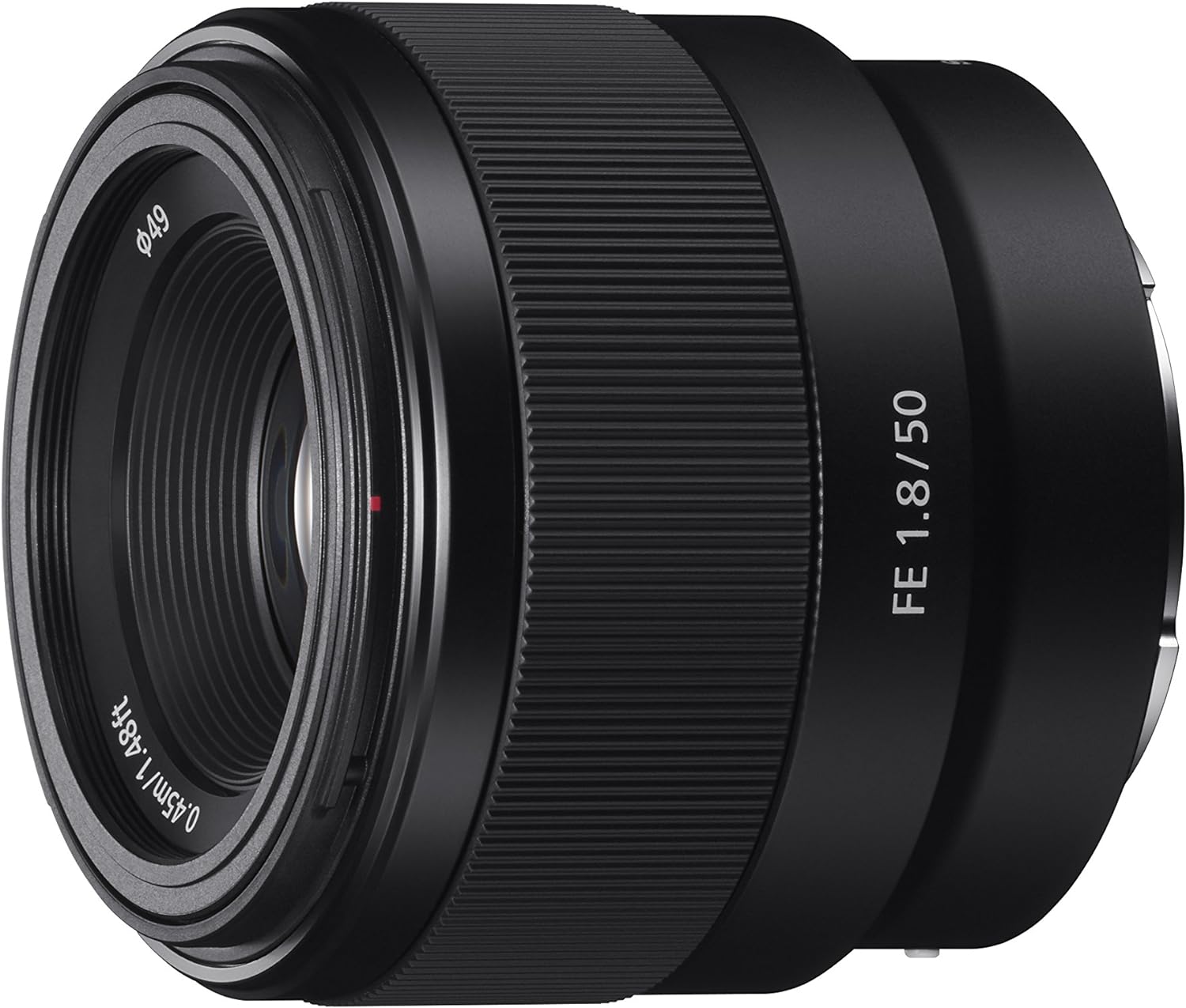
Two caveats to weigh. F/4.5 to f/6.3 is dark, so this is a daylight lens, and it is an E rather than FE lens, so it crops a full-frame body. And this listing is a Renewed unit rather than new, with new listings for the same lens available on separate ASINs at a higher price. For a lens this inexpensive the saving on a refurbished copy is small relative to the warranty you give up, which is worth thinking about before clicking.

Key Listed Features

01

APS-C E-mount 55 to 210mm, framing like 82 to 315mm, with a seven-blade aperture

02

Optical SteadyShot stabilisation, which is what makes a 315mm equivalent handholdable at f/6.3

03

Internal focusing with direct manual focus and a non-rotating focus ring during autofocus

04

Minimum focus distance of 3.28 ft with a 0.23x maximum magnification ratio

Buying questions

Quick Answers

Why does a non-rotating focus ring matter?

Two reasons, both practical. Any filter whose orientation matters, a circular polariser or a graduated neutral density, stays where you set it rather than being rotated out of position every time the lens refocuses. And normal telephoto technique involves supporting the lens barrel with your left hand, which on a rotating-ring design means fighting the focus mechanism. Internal focusing with a static ring is a mark of a reasonably modern design and is absent from several cheap telephotos still on sale.

Is 0.23x magnification useful on a telephoto?

It is more useful than the same figure on a wide lens, because you achieve it from 3.28 feet away rather than a few centimetres. Nearly a quarter of life size at arm's length means you can fill the frame with a flower, a butterfly or a plate without casting a shadow over it or scaring it off, which is exactly what a short macro lens struggles with. It is not a substitute for a true macro lens, but it covers a surprising amount of casual close-up work.