5 Best Bird Feeders for Backyard Birdwatching (2026)
Five verified bird feeders, from weight-activated squirrel-proof tube feeders to a suction-cup window feeder, compared on capacity, mechanism, and real-world tradeoffs.
Quick answer
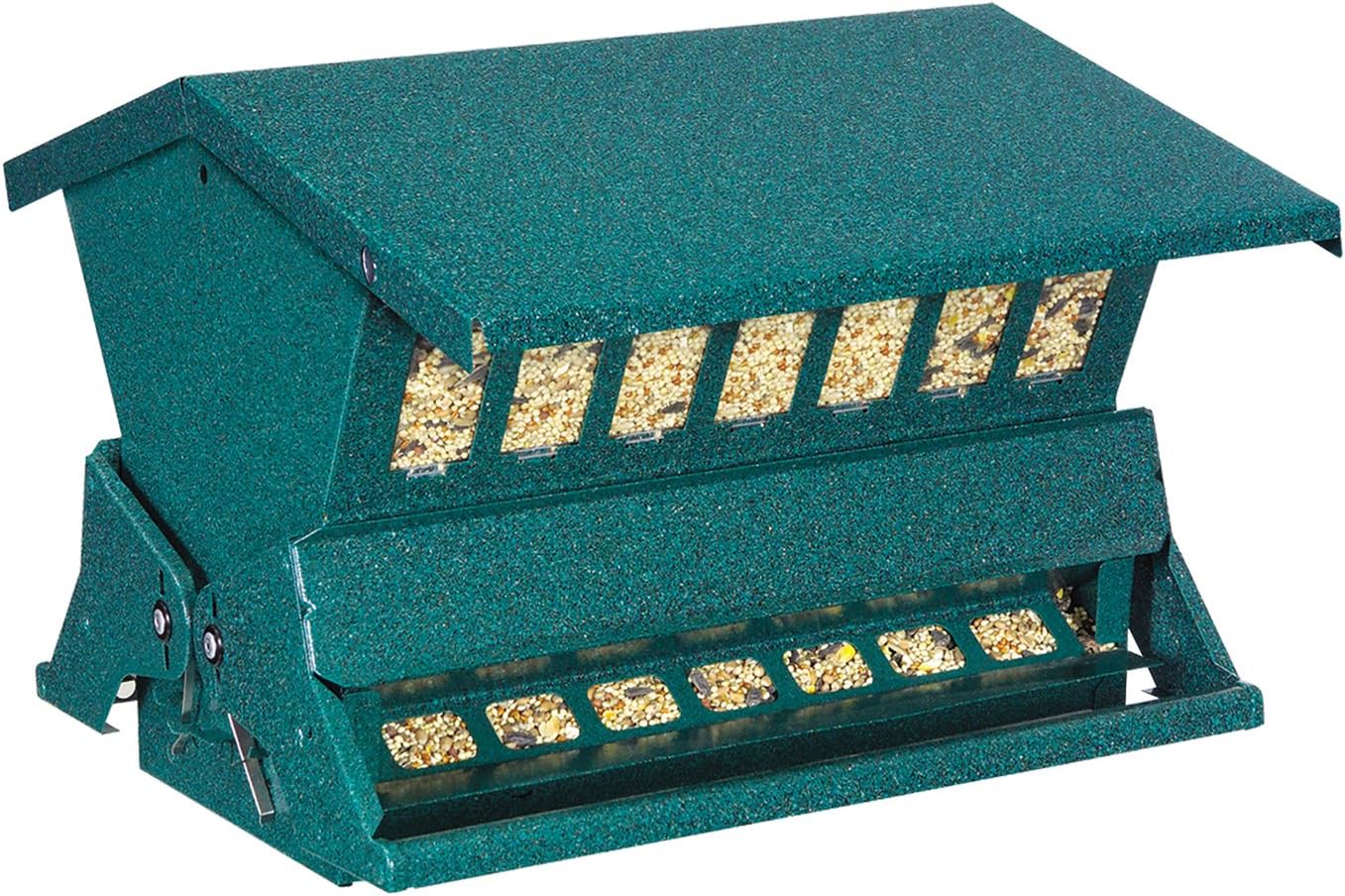
If you want the most tested approach to keeping squirrels out of a hanging tube feeder, the Brome Squirrel Buster Plus is the safest overall pick, its weight-activated shroud closing off all six feeding ports the moment a squirrel's weight lands on it. If you'd rather watch birds from a foot away rather than across the yard, the Nature Anywhere Window Bird Feeder suction-mounts straight to glass, which sidesteps the squirrel problem almost entirely since squirrels can't get purchase on a vertical window. Feeding a lot of birds at once and want a bigger reservoir, look at the Woodlink Absolute II, which trades a spring-loaded shroud for two weight-adjustable counterbalance perches and a 12-lb double-sided hopper. Prefer a mechanical, moving deterrent over a static one, the Droll Yankees Yankee Flipper spins squirrels off with a motorized, weight-activated perch. And if squirrel-proofing matters less to you than a good-looking copper accent piece that still draws a crowd, the Perky-Pet Copper Panorama is the budget, style-forward option, with the least aggressive anti-squirrel hardware of the five.
Updated September 2026Advertising DisclosureTop Relevant
✓Carefully researchedProduct data reviewed
◇Independent picksClear comparison criteria
▣Practical resultsBuilt around real use cases
$Price & valueFeatures compared clearly
Buyer checklist
How We Compared These 5 Bird Feeders for Bringing More Backyard Visitors Into View
This is desk research, not a hands-on test. We did not buy, hang, or fill any of these feeders ourselves, and we have no data on how squirrels in your specific yard will react to any of them. What we did do: pulled the current Amazon listing for each product (title, images, price range, and who the item ships from and is sold by) using a real Amazon product page fetch, cross-checked the brand and every capacity, port-count, and mechanism claim against the manufacturer's own product page (Brome, Droll Yankees, Woodlink, Perky-Pet, Nature Anywhere) and at least one independent wild-bird retailer where available, and discarded any candidate ASIN whose title or bullet points didn't match a clean, single-unit, currently-listed SKU. Two products required a specific SKU decision worth flagging: the Perky-Pet listing most commonly surfaced under the plain 'Copper Panorama' name (ASIN B07J4YQ9DP) is actually labeled in its own bullet points as a 2-pack case, so we swapped in the single-tier 517282/312C ASIN instead; and for Nature Anywhere we picked the standalone suction-cup sliding-tray feeder rather than the same brand's bundle listing that ships with a 5-lb bag of seed, so the comparison stays feeder-to-feeder. We also did not find a stable single-seller 'Buy Box' price for two of the five listings at the time of this research (multiple resellers were competing for the listing instead), so we're deliberately not quoting exact prices here since they were unstable even within our own research session, and by the time you read this the prices will have moved regardless. We're also being deliberately cautious about squirrel-proof claims: every mechanism here (weight-activated shrouds, spring perches, motorized perches, suction-mounted glass) is a real, functioning deterrent per its manufacturer, but squirrels are notoriously persistent and adaptable, and no manufacturer we checked claims 100% exclusion.
5 Bird Feeders for Bringing More Backyard Visitors Into View Buying Questions
Do squirrel-proof bird feeders actually keep squirrels out completely?
No feeder is completely foolproof. Weight-activated shrouds, spring-loaded perches, and motorized perches all work by using an adult squirrel's body weight against it, and manufacturers are upfront that the mechanisms can still be beaten by lightweight juvenile squirrels, chipmunks, or squirrels that jump directly onto the feeder from a nearby branch or railing instead of climbing up from the ground. Brome, for example, states its Squirrel Buster line will not deter juvenile squirrels, chipmunks, or larger animals like raccoons, and recommends at least 18 inches of open clearance around the feeder so nothing can jump onto it. Treat every squirrel-resistance claim as 'meaningfully reduces' rather than 'eliminates.'
Where should I hang or mount a bird feeder to get the most visitors?
Most backyard-birding guides recommend keeping feeders within 3 feet or beyond 30 feet of windows to reduce fatal window strikes, since birds startled at close range don't have time to build up dangerous speed and birds far away have time to correctly perceive the glass. Cover and a water source nearby also matter more for attracting a variety of species than the feeder itself. A window-mounted feeder like the Nature Anywhere sidesteps the collision-distance question entirely because it sits directly on the glass.
How often do bird feeders need to be cleaned?
Wildlife and extension-office guidance generally recommends cleaning tube and hopper feeders every 2 weeks, and more often in humid or rainy weather, to reduce mold and the spread of avian diseases like salmonellosis and house finch eye disease at shared feeding stations. Feeders with fewer nooks (open platforms, wide-mouth tubes) are easier to scrub with a bottle brush and diluted (roughly 1:9) bleach solution than feeders with tight internal channels.
What seed should I use to attract the widest range of backyard birds?
A basic black-oil sunflower seed or a no-waste mix without milo/red millet filler is the most broadly recommended starting point across the wild-bird-feeding guides we cross-checked, since it appeals to cardinals, chickadees, finches, and jays alike without producing the discarded-husk pile that cheaper mixes create underneath the feeder.