TopFiveFind may earn from qualifying purchases. Rankings are editorial starting points, not hands-on test claims.
Home/Vacuum Sealers/Linkind A19 LED Light Bulbs Dimmable, 60W Equivalent, Energy Efficient 9W, 2700K, 800 Lumens, E26 Standard Base
Linkind A19 LED Light Bulbs Dimmable, 60W Equivalent, Energy Efficient 9W, 2700K, 800 Lumens, E26 Standard BaseProduct image from current catalog data
Best Overall

Linkind A19 LED Light Bulbs Dimmable, 60W Equivalent, Energy Efficient 9W, 2700K, 800 Lumens, E26 Standard Base

By Linkind

9.8Excellent matchFeature and use-case score

The only dimmable bulb on this page, which makes it the only one of the five that works on a dimmer circuit at all, at 800 lumens and 2700K.

  • Dimmable and compatible with most LED dimmers, the only bulb in this guide that is
  • 800 lumens from 9W, roughly 89 lumens per watt, on an E26 base at 120V with no warm-up
  • 2700K warm white, with the listing explaining the Kelvin scale rather than assuming it
See Price at the store →Price, delivery, and configuration can change at the retailer.
ByTopFiveFind Research Desk

How this was made: AI-assisted research and drafting organize the evidence. Exact product identity, source claims, owner-feedback patterns, conflicts, and publication checks are documented before indexing. No hands-on or human-expert testing is claimed unless a page explicitly shows that evidence. Read the full methodology.

Best fitBest Overall
CategoryVacuum Sealers
BrandLinkind
Catalog score9.8 / 10

Product overview

Linkind A19 LED Dimmable: What to Know

Dimmability is the reason this leads and it is not a marginal advantage. Every other bulb in this comparison is explicitly non-dimmable, and a non-dimmable LED on a dimmer switch flickers, buzzes, refuses to light at low settings and fails early. If any fitting in your house is dimmed, four of the five bulbs here are simply the wrong product, and Linkind states compatibility with most LED dimmers with smooth dimming.

The output figures are mainstream and sensible: 800 lumens from 9 watts, which works out to roughly 89 lumens per watt, on an E26 standard base at 120V with no warm-up time. That is a full 60-watt replacement and sits in the middle of this group's efficiency range.

The color temperature is 2700K warm white, which Linkind describes as a cosy, relaxing atmosphere, and the listing does something unusual and genuinely helpful: it explains the Kelvin scale directly, noting that lower Kelvin values produce warmer, yellower light. That is the single most common point of confusion in this category and almost no manufacturer bothers.

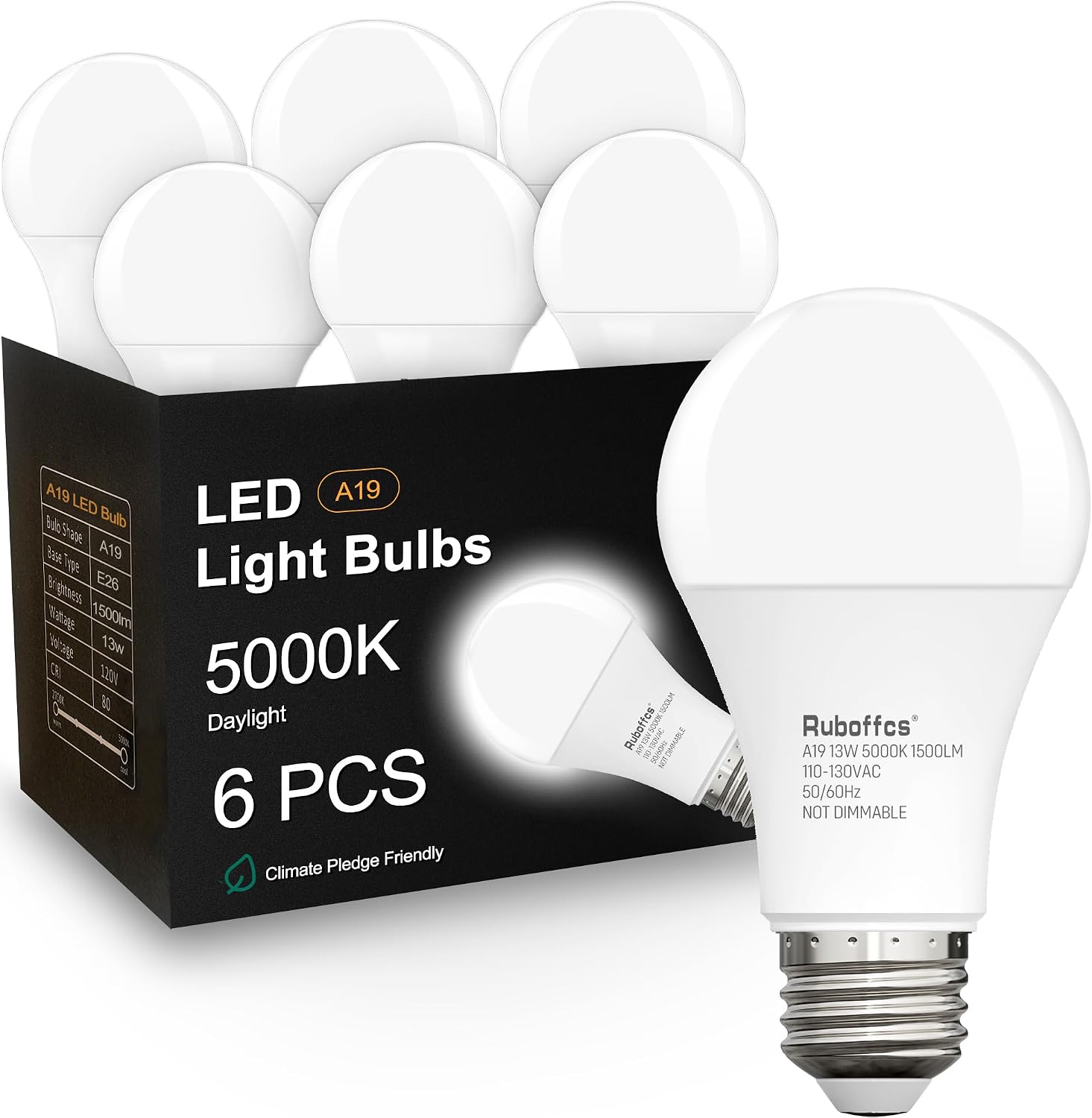
The lifespan claim is 15,000 hours, which Linkind expresses as at least 13 years based on three hours a day, the longest in this guide alongside the Ruboffcs and comfortably ahead of the Sylvania's 7,700. The warranty is 2 years, second only to Philips here, and the listing claims up to 85 percent energy savings against the incandescent bulb it replaces.

Two honest notes. Dimmable LEDs are compatible with most but not all dimmers, particularly older rotary dimmers designed for incandescent loads, so a buzz or a limited dimming range can still happen and is a dimmer problem rather than a bulb fault. And at 2700K this is a living-room and bedroom bulb; for a kitchen or garage the 5000K options here are the right choice.

Key Listed Features

01

Dimmable and compatible with most LED dimmers, the only bulb in this guide that is

02

800 lumens from 9W, roughly 89 lumens per watt, on an E26 base at 120V with no warm-up

03

2700K warm white, with the listing explaining the Kelvin scale rather than assuming it

04

Rated 15,000 hours, stated as at least 13 years at three hours a day, with a 2-year warranty
Buying questions

Quick Answers

How do I know if my switch is a dimmer?

A dimmer has a slider, a rotary dial, or a push-and-hold button rather than a simple on-off toggle, and in a modern installation it is usually obvious. The case that catches people out is a smart switch or a multi-way circuit where one of several switches is dimming, in which case the whole circuit needs dimmable bulbs. If you are unsure, fitting a dimmable bulb is the safe default: a dimmable LED works perfectly on a plain switch, while a non-dimmable one on a dimmer does not. That asymmetry is a good reason to standardize on dimmable.

Does dimming an LED save energy?

Yes, though less proportionally than you might expect. Dimming reduces the power drawn, so a bulb at half brightness uses meaningfully less than at full, but LED drivers are least efficient at the bottom of their range so the saving is not linear. The stronger argument for dimming is not energy but use: a light you can set to a comfortable level gets left on at a low setting rather than switched between glaring and off, which is a quality-of-life gain rather than a bill one.