Buyer checklist
How We Compared These A19 LED Light Bulbs
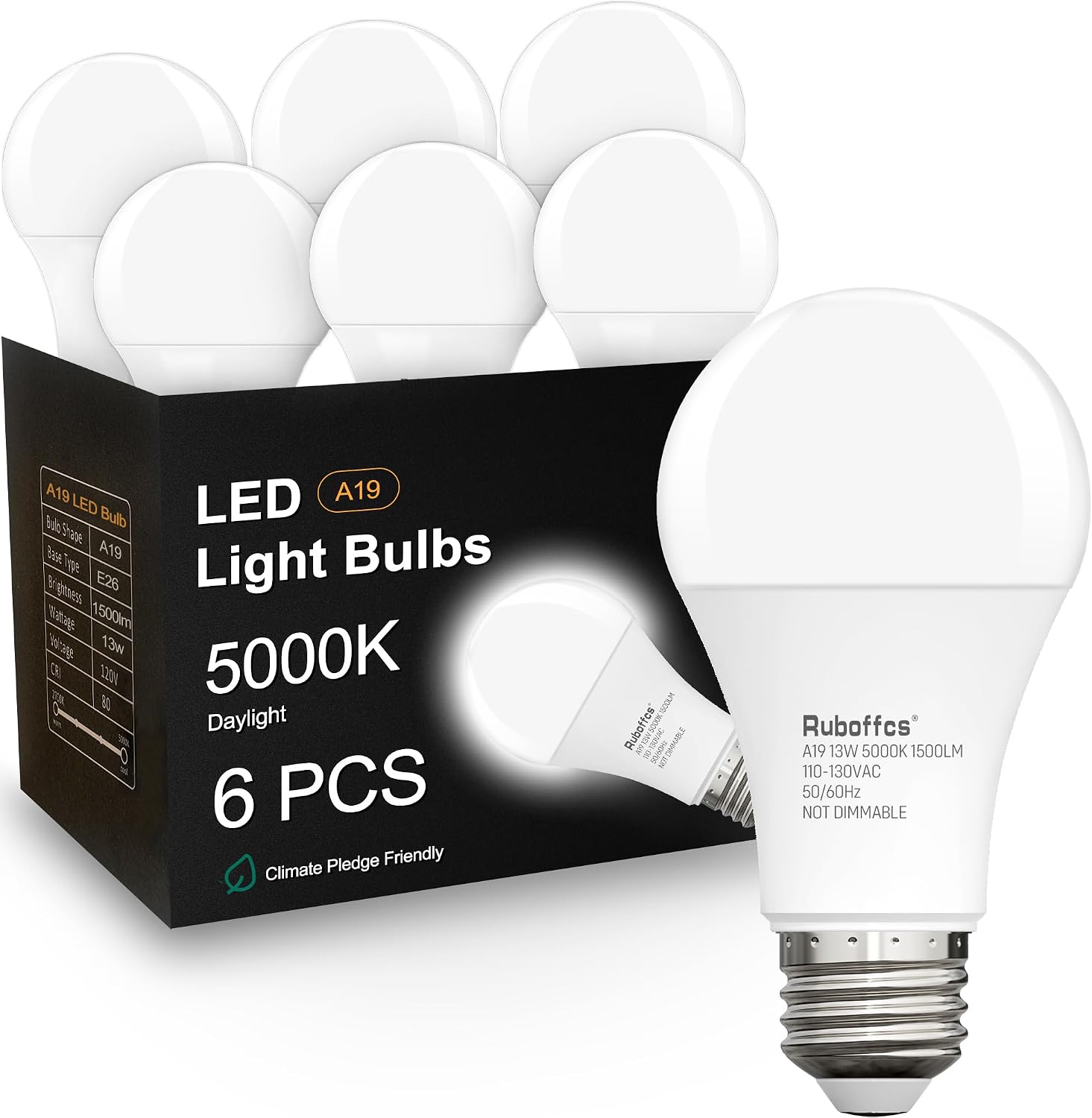
We put all five on the same three axes, because the packaging does not. Lumens, which is the actual light output and the only brightness figure that compares across brands. Color temperature in Kelvin, which determines whether a room reads as warm or clinical and cannot be changed after purchase. And dimmability, which turns out to be the dividing line in this group: four of the five are explicitly non-dimmable, and putting a non-dimmable bulb on a dimmer circuit causes flicker, buzzing and premature failure. We also normalised the lifespan claims, which arrive in several different units across these listings, 7 years, 11,000 hours, 7 years at three hours a day, over 15,000 hours and 13 years at three hours a day, into hours where the manufacturer gives enough to do so. Every figure below is the manufacturer's own, read off the live Amazon.com listing including the detail tables. Nothing here was installed, metered or burned in by us, and no lifespan claim has been verified.
A19 LED Light Bulbs Buying Questions
Why is watt-equivalent the wrong number to shop by?
Because it is a marketing translation, not a measurement. Watts describe the electricity a bulb consumes, and in the incandescent era that correlated closely with brightness, so people learned to shop by wattage. LEDs broke that link: these five bulbs draw between 6.5 and 13 watts while producing between 450 and 1,500 lumens, and the efficiency varies by brand. Sixty-watt equivalent is each manufacturer's claim about which old bulb theirs replaces, and they are not consistent with one another. Lumens is the output figure and the only one that compares directly, which is why it is the number to read.
What happens if I put a non-dimmable bulb on a dimmer?
It misbehaves and usually dies early. A non-dimmable LED has a driver designed for full mains voltage, and a dimmer chops that waveform, which the driver is not built to handle. The symptoms are flickering, audible buzzing, the bulb refusing to turn on at low settings, or jumping straight to full brightness, and the electrical stress shortens its life considerably. It is not a fire risk in a modern fitting but it is a wasted bulb. Of the five here, only the Linkind A19 states dimmer compatibility, which makes it the single option for a dimmed circuit.
Should I buy 2700K or 5000K?
Match it to the room, and know that you cannot change it later. 2700K is warm white, the yellowish tone of an old incandescent bulb, which suits living rooms, bedrooms and anywhere meant to feel relaxing. 5000K is daylight, a cool blue-white that reads as clean and clinical, correct for kitchens, garages, bathrooms, workshops and task lighting and widely disliked in a bedroom. In this group the Linkind, Sylvania and Philips are 2700K and the Ruboffcs and dalattin are 5000K, so the color decision narrows your choice before any other specification does. Mixing both in one open-plan room is the common mistake.