TopFiveFind may earn from qualifying purchases. Rankings are editorial starting points, not hands-on test claims.

Board Games for Preschoolers: 4 Picks by Age

First Orchard at 2+, Sneaky Snacky Squirrel at 3+, Count Your Chickens and Monza at 5+. One of these four contradicts its own stated age, and we say which.

Updated September 2026Advertising DisclosureTop Relevant
✓Carefully researchedProduct data reviewed
◇Independent picksClear comparison criteria
▣Practical resultsBuilt around real use cases
$Price & valueFeatures compared clearly
ByTopFiveFind Research Desk

How this was made: AI-assisted research and drafting organize the evidence. Exact product identity, source claims, owner-feedback patterns, conflicts, and publication checks are documented before indexing. No hands-on or human-expert testing is claimed unless a page explicitly shows that evidence. Read the full methodology.

#1
HABA My Very First Games - First Orchard Toddler Game - My First Orchard Game, Cooperative Toddler Board Games for 2 Year Olds

HABA My Very First Games - First Orchard Toddler Game - My First Orchard Game, Cooperative Toddler Board Games for 2 Year Olds

HABA

Why we like it
  • HABA recommended age of 24 months to 3 years, for one to four players
  • Fully cooperative: all players work together against the raven, so nobody is eliminated
  • Wooden components made from PEFC certified wood, sized for a two-year-old's grip
HighlightHABA recommended age of 24 ...Rank#1
Read the Full Review →
#2
Educational Insights The Sneaky, Snacky Squirrel Game - Toddler Board Games for 3 Year Olds, Fine Motor Skills Toys

Educational Insights The Sneaky, Snacky Squirrel Game - Toddler Board Games for 3 Year Olds, Fine Motor Skills Toys

Educational Insights

Why we like it
  • Includes Sneaky the Squirrel Squeezer, 20 acorns in five colours, a spinner, four logs and a ...
  • Tree-shaped game board that doubles as the box lid
  • Manufacturer recommended age of 36 months to 7 years, for up to four players
HighlightIncludes Sneaky the Squirre...Rank#2
Read the Full Review →
#3
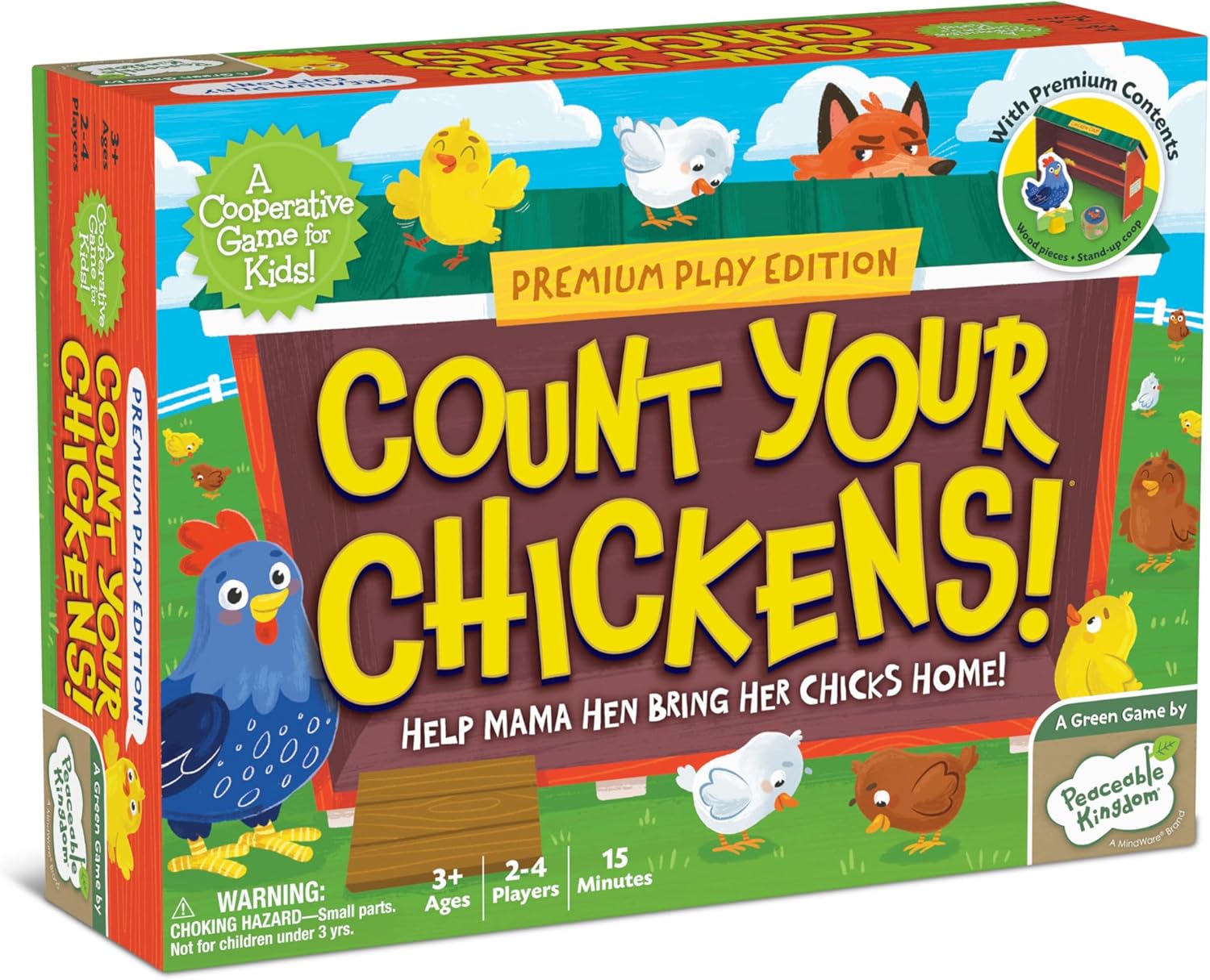
Peaceable Kingdom Count Your Chickens Cooperative Game, Premium Edition | Premium wood edition of the award-winning cooperative counting game

Peaceable Kingdom Count Your Chickens Cooperative Game, Premium Edition | Premium wood edition of the award-winning cooperative counting game

Peaceable Kingdom

Why we like it
  • Fully cooperative: players work together to return the chicks to Mama Hen, with no competitiv...
  • Premium wood edition with wooden hen and chick pieces, a chicken coop, spinner and illustrate...
  • Stated for 2 to 4 players, with counting built into the movement mechanic rather than added on
HighlightFully cooperative: players ...Rank#3
Read the Full Review →
#4
HABA Monza Car Racing Board Game for Kids, Color Matching Strategy Game, Ages 5+

HABA Monza Car Racing Board Game for Kids, Color Matching Strategy Game, Ages 5+

HABA

Why we like it
  • HABA stated age of 5 and up, for up to six players, with six durable wooden cars
  • Colour-dice matching mechanic that forces a route decision each turn rather than simple roll-...
  • Twenty modular track tiles, so the course is reconfigured for every game
HighlightHABA stated age of 5 and up...Rank#4
Read the Full Review →

Top Picks At a Glance

ProductRankBrandBest ForScore
HABA My Very First Games - First Orchard ...#1HABABest for Two-Year-Olds9.8
Educational Insights The Sneaky, Snacky S...#2Educational InsightsBest for Three-Year-Olds9.6
Peaceable Kingdom Count Your Chickens Coo...#3Peaceable KingdomBest Cooperative Counting Game9.4
HABA Monza Car Racing Board Game for Kids...#4HABABest for Five-Year-Olds9.3

Buyer checklist

How We Compared These Board Games for 2 to 5 Year Olds: The Stated Minimum Age Is the Whole Specification

Every age, player count and component list below is the publisher's own stated figure, read off the live Amazon.com listing including the detail tables, and we have named the publisher in each case: HABA, Educational Insights and Peaceable Kingdom. At this age range the stated minimum age is the most consequential specification a game has, so we checked it in both places each listing states it, the feature bullets and the manufacturer recommended age field, and found one direct contradiction, which is reported in that product's section rather than averaged away. We also recorded what is physically in each box, because at two and three years old the components are the game: a wooden piece a toddler can grip is a different product from a cardboard token. We did not play these with children, time a session or assess any developmental claim, and the skills each publisher attributes to its game are their claims rather than measured outcomes. Award citations are quoted as the publisher states them.

Board Games for 2 to 5 Year Olds: The Stated Minimum Age Is the Whole Specification Buying Questions

Can a two-year-old really play a board game?

A cooperative one with wooden pieces and almost no rules, yes. What a two-year-old can do is take a turn, follow one instruction and put a piece somewhere, and HABA's First Orchard is built around exactly that, with a manufacturer recommended age of 24 months to 3 years. What they cannot do is lose gracefully, wait through three other players, or hold a strategy, which is why the game is cooperative and why nothing on this page below three years old is competitive. The realistic expectation is a five-minute shared activity rather than a game night.

Cooperative or competitive at this age?

Cooperative until roughly four, and it is not a close call. Two of the four games here are explicitly cooperative, First Orchard and Count Your Chickens, and both publishers give the same reason: it removes the competitive pressure that ends a session in tears. A three-year-old losing to a five-year-old sibling is the most reliable way to make a game unpopular. Competitive play starts working once a child can understand that losing a game is not a verdict on them, which for most children is somewhere around four or five, which is where Monza sits.

Why do stated ages differ so much between listings?

Because they are publisher recommendations rather than a tested standard, and publishers weigh different things: component size and choking risk, reading requirement, rules complexity, attention span and, less honestly, marketability. That is why you will see the same game listed at 3 and up in one place and 6 and up in another, which is exactly what happens on the Count Your Chickens listing in this guide. The practical approach is to read the component list and the mechanic rather than trusting the number: a game needing counting to ten needs a child who can count to ten, whatever the box says.

Similar Products You Might Like

Educational Insights The Sneaky, Snacky Squirrel Game - Toddler Board Games for 3 Year Olds, Fine Motor Skills Toys

Educational Insights The Sneaky, Snacky Squirrel Game -...

9.6

View Deal
Peaceable Kingdom Count Your Chickens Cooperative Game, Premium Edition | Premium wood edition of the award-winning cooperative counting game

Peaceable Kingdom Count Your Chickens Cooperative Game,...

9.4

View Deal
HABA Monza Car Racing Board Game for Kids, Color Matching Strategy Game, Ages 5+

HABA Monza Car Racing Board Game for Kids, Color Matchi...

9.3

View Deal

Sign up and get exclusive special deals