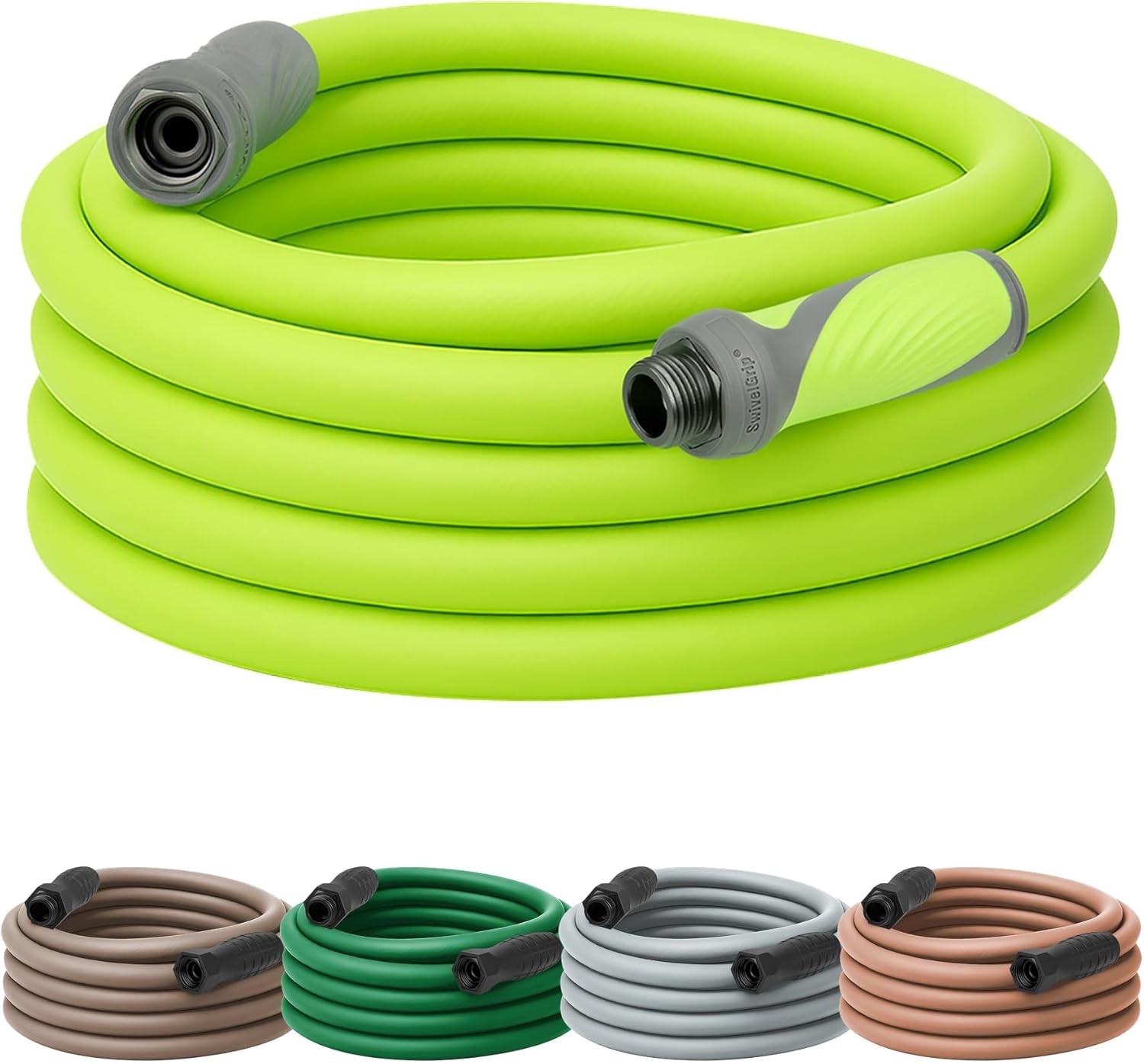
5 Garden Hoses That Are Easier to Handle and Store
Five lightweight, kink-resistant garden hoses we compared on real Amazon listings and manufacturer specs, picked for easy coiling, hauling, and storage.
Quick answer
If you just want the easiest hose to drag around the yard and coil back up without a fight, the Flexzilla Garden Hose with SwivelGrip is the safest bet: it is genuinely lightweight, its swivel fitting stops the hose from twisting itself into knots while you connect it, and Amazon sells and ships it directly. The zero-G 4001-50 is the pick for anyone who wants that same lightweight feel from a hose that reads as more of a commercial-grade tool, and the Giraffe Tools hybrid hose (in the 100 ft length that was actually in stock at research time) is the one to reach for if you need serious reach without a rigid rubber hose fighting you the whole way. Two of our five picks are not the exact products originally drafted for this guide -- we swapped them out and explain exactly why in each writeup below.
Updated September 2026Advertising DisclosureTop Relevant
✓Carefully researchedProduct data reviewed
◇Independent picksClear comparison criteria
▣Practical resultsBuilt around real use cases
$Price & valueFeatures compared clearly
Buyer checklist
How We Compared These 5 Garden Hoses That Are Easier to Handle and Store
This is desk research, not a hands-on test -- nobody on our team coiled, kinked, or burst these hoses in a yard. What we did instead: for every candidate, we pulled the live Amazon product page (title, images, price, stock status, and seller information), cross-checked the manufacturer's own spec claims where the brand publishes them, and looked at each listing's own bullet points and product description rather than assuming specs from other lengths or other sellers' listings. Two of the five products originally on our shortlist -- the ELEY Polyurethane Garden Hose and the original Craftsman Premium Rubber Garden Hose listing -- turned out not to be currently purchasable on Amazon in any length we checked (both showed 'Currently unavailable' with no working buy box, and neither turned up in Amazon's own on-site search results for the brand name), so we substituted real, currently in-stock, comparable products and say so plainly in those two writeups. Where a listing made a specific claim -- drinking-water safety, lead-free material, a burst-pressure number -- we only repeated it here if we could find that exact claim stated on that exact product's own Amazon listing, not assumed from a sibling product or a different length.
5 Garden Hoses That Are Easier to Handle and Store Buying Questions
Does hose diameter (1/2 in. vs. 5/8 in.) actually matter for handling?
Yes. A 1/2-inch hose is noticeably lighter and easier to coil than a 5/8-inch hose of the same length, but it also delivers less water flow -- fine for containers and small beds, frustrating if you're filling a pool or running a sprinkler that wants more volume. All five hoses in this guide are 5/8-inch, which is the standard middle ground for a general-purpose residential hose; if easy handling is your only priority and you don't need max flow, sizing down to 1/2-inch on any of these brands (where offered) will shave off more weight.
What actually makes a hose 'kink-resistant,' and is it foolproof?
Kink resistance mostly comes down to the hose wall material and how it's reinforced -- hybrid polymer and polyurethane hoses generally resist kinking better than plain rubber or vinyl because they have less 'memory' and don't hold a bent shape. That said, no garden hose is kink-proof: a sharp fold under water pressure, a hose run over a hard 90-degree edge, or extreme cold can still kink even a hose marketed as kink-resistant. Think of it as 'kinks less easily and un-kinks itself faster,' not 'cannot kink.'
Do I need a 'drinking water safe' or 'lead-free' hose?
Only if you'll actually drink from it, fill a pet's water bowl from it, use it to fill a rain barrel that waters edible plants, or hook it to an RV. Standard garden hoses can leach trace amounts of chemicals from their fittings or liner and aren't required to meet drinking-water standards, so if that matters to you, buy a hose whose Amazon listing or manufacturer page explicitly says lead-free/drinking-water-safe -- don't assume it from the hose looking 'clean' or being a known brand. We only labeled a pick that way in this guide when we found the claim stated on that specific listing.
Why does a hose that's 'lighter' matter if the length and diameter are the same?
Weight comes from the wall material and the fittings, not just length and diameter. A 50-foot hybrid-polymer or polyurethane hose can weigh noticeably less than a 50-foot all-rubber hose of the same diameter, which is the whole reason lightweight-hose categories exist -- less arm fatigue dragging it across the yard, easier one-handed coiling, and less strain on hose reels and hangers rated for lighter loads.
What's the easiest way to store any of these hoses to make them last longer?
Drain the hose and coil it loosely (avoid tight coiling that reintroduces a 'memory' kink) in a shaded spot, off direct sun and away from freezing temperatures if you're in a climate that gets hard frost -- water left in a rigid rubber hose can crack the lining when it freezes and expands. A wall-mounted reel, hose hanger, or simple loose coil on a hook all work; what matters more than the storage method is emptying the hose first and not leaving it kinked under tension.