Buyer checklist
How We Compared These Nikon DSLR Lenses: AF-P Will Not Work on a Long List of Nikon Bodies
These are all genuine Nikon products with published specifications, and the figures below come from Nikon's own listing copy: focal lengths, aperture ranges, picture angles in degrees, minimum focus distances measured from the focal plane, maximum reproduction ratios, filter thread sizes, motor types and 35mm-equivalent framing. As with the Canon lenses we compared, the Amazon detail tables are unreliable, giving a 140mm focal length as 14 centimetres and listing optical stabilisation on the 50mm f/1.8G, which has none, so we ignored the tables entirely. The compatibility lists for the AF-P lenses are quoted directly from Nikon's listing text because they are the single most consequential specification in the group. Two listing conditions to note: several of these lenses also appear as Renewed or 90-day-warranty units under separate ASINs, and we have used standard listings where one exists and said so where the product ships as a bundle instead. Nothing here was mounted or tested by us.
Nikon DSLR Lenses: AF-P Will Not Work on a Long List of Nikon Bodies Buying Questions
Which Nikon bodies do AF-P lenses not work on?
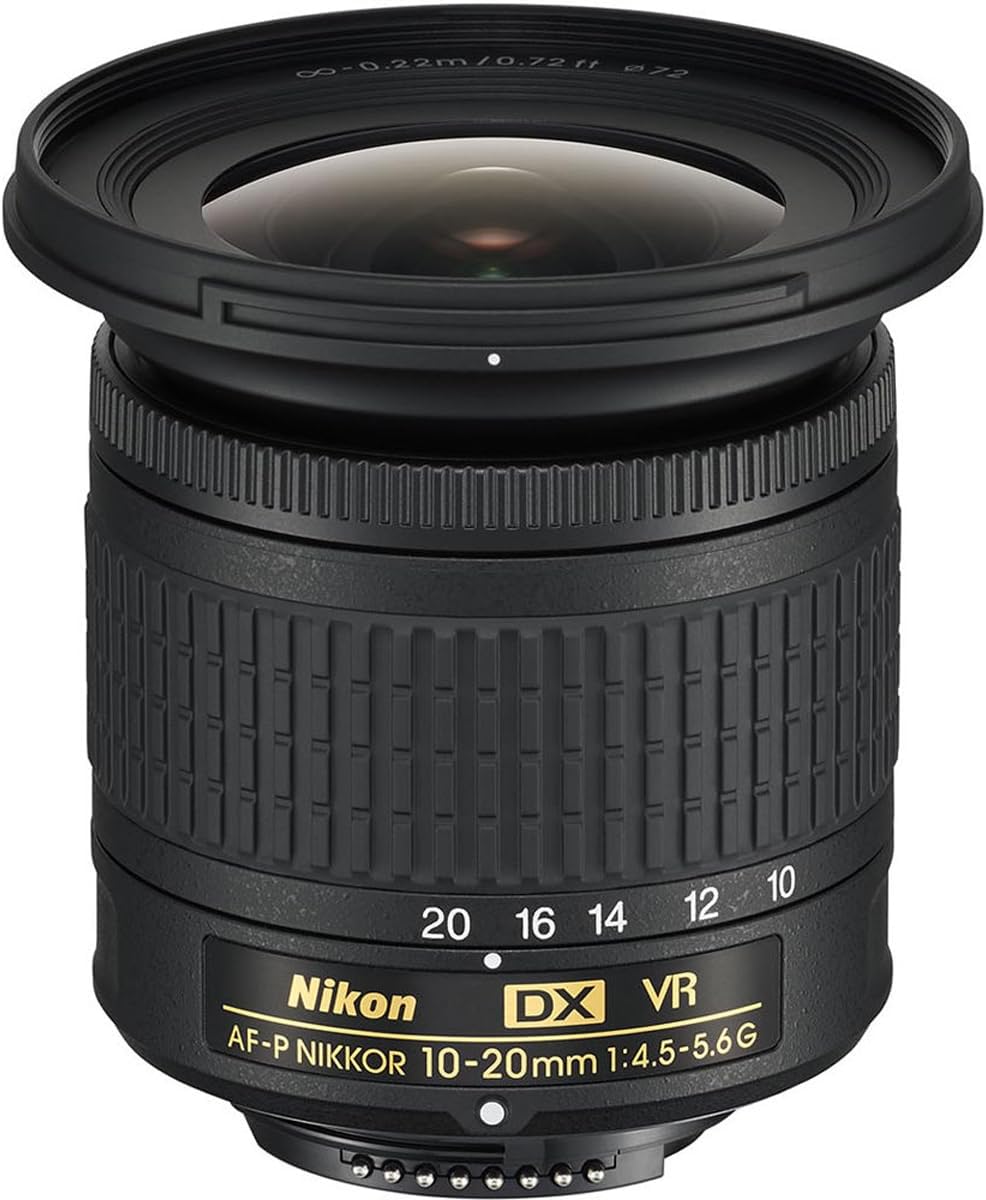
Nikon publishes the list, and quoting it is more useful than summarising it. Incompatible: the D4 series, D3 series, D2 series, D1 series, D800 series, D700, D610, D600, D300 series, D200, D100, D7000, D5100, D5000, D90, D80 and D70 series. Limited function: D5, D810 series, Df, D750, D7200, D7100, D5200, and Nikon 1 bodies with the FT1 adapter. Fully compatible: D7500, D5600 and newer. A firmware update may be required even on compatible bodies. If your camera is on the incompatible list, an AF-P lens is not a lens you can use, and that includes several bodies that are otherwise perfectly capable.
What is the difference between AF-S and AF-P?
The focus motor and how the lens is controlled. AF-S uses Nikon's Silent Wave Motor and behaves like a conventional lens with physical switches on the barrel. AF-P uses a pulse or stepping motor, which is quieter and smoother for video, but it removes the physical controls: Nikon's own bullet says you access lens settings in the camera menu. That is why older bodies cannot drive them, because those cameras have no menu entries for a lens that expects to be configured that way. AF-S is the safe choice across a wide range of bodies; AF-P is better for video on a recent body.
Does a DX lens work on an FX Nikon body?
It mounts and it works, with a penalty. A DX lens projects an image circle sized for Nikon's APS-C sensor, so on an FX full-frame body the camera switches to DX crop mode and uses the central portion of the sensor, which on a 24-megapixel FX body leaves you around 10 megapixels. Three of the five lenses here are DX. The 50mm f/1.8G is the FX lens in this group, and Nikon states it is optimised for edge-to-edge sharpness on both formats, which makes it the one lens here that is not a compromise on either kind of body.